Depositing Bitcoin at Esports Books
Short answer: Generate a fresh deposit address from the book, send a small test amount first from a wallet you control, and expect credit after the operator's own confirmation policy - commonly 1-3 confirmations (10-30 minutes). Lightning deposits credit near-instantly where supported.
A bitcoin deposit is the moment where "crypto sportsbook" stops being marketing and becomes plumbing. The mechanics are simple; the failure modes are what eat money. This walkthrough follows a deposit from wallet to betting balance, with the checks that prevent each classic failure.
table of contents
Before anything moves
Three pre-deposit checks, in order:
- Confirm the coin and network on the operator's own deposit page - not a review site's claim, not last month's memory. Books change processors; a page that said BTC-on-Lightning last month may say BTC-on-Lightning-and-Liquid now. Sending to the wrong network is the most expensive typo in betting [1].
- Send a small test amount first. $5-10 equivalent, watch it credit, then send the real deposit. The test costs a network fee; skipping it risks the whole deposit on a mistyped address or a currency conversion surprise.
- Check the minimum. Most books set minimums in fiat-equivalent terms (our comparison table lists documented minimums) - a deposit below it can sit uncredited or be eaten by processing fees [1].
The address, step by step
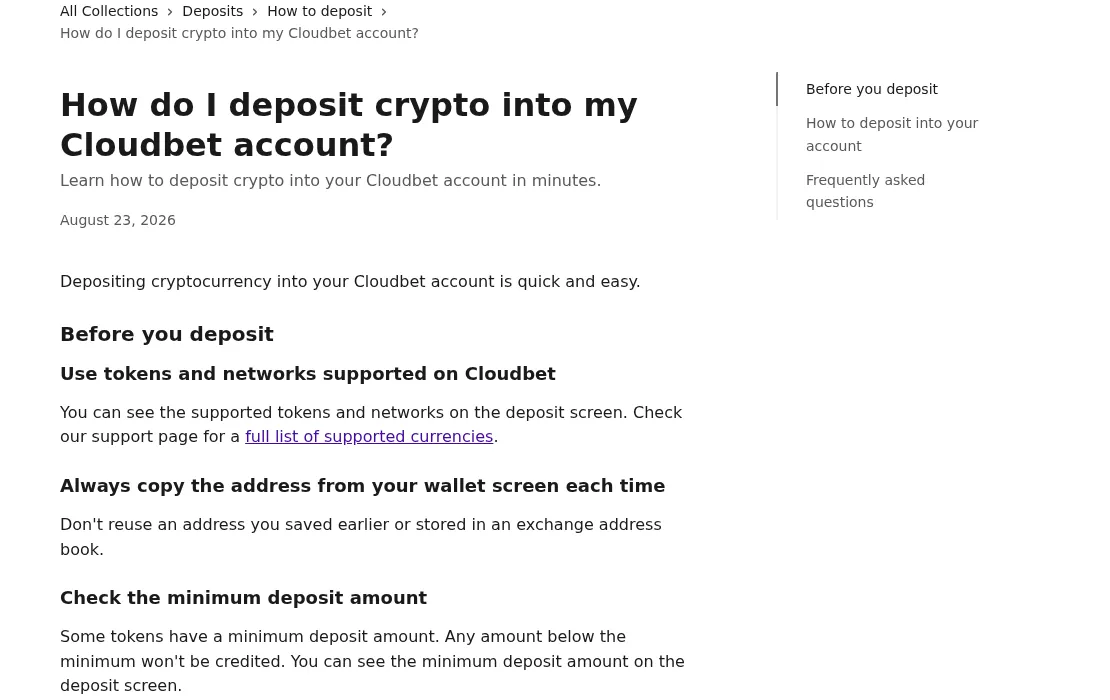
The operator generates a fresh deposit address per deposit - use it once, every time. Cloudbet's own help center puts it in exactly those words: always copy the address from the wallet screen each time, never reuse a saved address or one stored in an exchange address book [1]. Address reuse across deposits is what allows third parties to connect your betting activity, even between different books if you copied addresses from an old session [5].
- Open the book's deposit page, select BTC (and the correct network - native SegWit addresses start with
bc1). - Copy the address from the site, not from your clipboard history or a screenshot.
- Paste into your wallet and verify the first and last characters match - clipboard hijacking malware rewrites addresses, and the chain does not reverse [2].
- Set a fee that clears today: most wallets default to a sane rate; during congestion, bump it. An unconfirmed transaction is not lost - it is waiting, and with RBF-enabled wallets it can be fee-bumped.
- Record the transaction ID before you close anything. It is the evidence if a support ticket becomes necessary [2].
What the book does with it
Your transaction lands in the mempool, gets mined, and then the operator's wallet watches for confirmations. The operator's own confirmation policy decides when your balance credits - commonly 1-3 confirmations for BTC, which is 10-30 minutes of wall-clock time [4]. The reviews on this site list each operator's documented policy where it publishes one; many do not, which is itself worth knowing before a large deposit.
Where a book does publish the numbers, they vary by asset: Roobet's help center documents 1 confirmation for BTC/LTC/XRP/TRX/DOGE and 3 for ETH/USDT/USDC - and, notably, a 100%-wager-before-withdrawal rule that gates withdrawals on top of confirmations [4]. That is why the test send matters: it measures the actual credit time on the network and rail you are using, not the marketing "instant".
Deposits that arrive from mixing services or flagged clusters can trigger delayed review at some books - not theft, just AML plumbing. It is one more reason funds sourced through the no-KYC routes and a small test deposit beat a large first send.
Lightning deposits
Several tracked books support Lightning. The flow differs: the book generates an invoice (or a Lightning address), your wallet pays it, and the balance credits in seconds - no confirmations exist on Lightning, settlement is instant between channels [3]. Fees are usually a rounding error. Two caveats: routes to the operator's node need capacity, so large deposits can fail to route, and a book that supports Lightning for deposits may still pay withdrawals on-chain.
| On-chain BTC | Lightning | |
|---|---|---|
| Credit time | Operator's policy, commonly 10-30 min | Seconds |
| Fees | Network fee, varies with mempool | Usually negligible |
| Failed sends | Rare once broadcast; stuck until fee bump | Route can fail on low inbound capacity |
| Withdrawal support | Standard | Not always enabled by the book |
The classic failure modes
Almost every "the book stole my deposit" case reduces to one of four things:
- Wrong network. Sending BTC on a chain the book does not support, or USDT on the wrong chain, is unrecoverable by the operator. The deposit page's network label is the only source that counts [1].
- Address reuse or a copy-paste swap. Clipboard malware and reused addresses both end in funds going elsewhere or in a public link between accounts [2].
- Below-minimum deposits. Small amounts can be swallowed by processing fees - the minimum exists for a reason [1].
- Mixing-service sources. A deposit flagged by the operator's AML tooling may be held for review. Keep the txid and the address; support can usually trace and clear it.
After the credit
Once the balance shows, the deposit is the book's liability, not your coins. That is the deal everywhere - which is why the operator facts on this site (license, the payout facts in our comparison table, reputation) matter more than the deposit experience. Deposit friction is symmetric; withdrawal friction is where operators differentiate [4].
Keep the deposit receipt - txid, amount, date - until you have completed at least one withdrawal. If money ever gets stuck, the payment help tool walks through diagnosis and drafts the support message locally, without sending anything anywhere.
Books with documented BTC cashiers
The comparison table carries the live values, but these three are the operators whose deposit pages we could verify on the last pass:
| Book | KYC | VPN | Min deposit | Payout | Score | |
|---|---|---|---|---|---|---|
| Cloudbet | Risk-based KYC | VPN tolerated | see review | ~10 min | 7.9 | Visit |
| Thunderpick | Risk-based KYC | VPN tolerated | $1.27 | varies | 7.4 | Visit |
| Stake | Risk-based KYC | VPN restricted | see review | varies | 7.2 | Visit |
Live values from our database - details and caveats in each review. "Visit" links may be affiliated.
The one-sentence summary
Fresh address, small test send, verified paste, patience for the operator's confirmation policy - and a recorded transaction ID, because the difference between a stuck deposit and a lost one is usually just paperwork.
The whole flow is deliberately boring: the operators that lose deposits are the ones where a step was skipped under time pressure, usually the test send. If the book supports both networks, prefer native SegWit addresses for on-chain sends - lower fees and no ambiguity about the network field. Keep a small reserve of bitcoin in your wallet rather than depositing your full stack - top-ups should never wait on a book support queue.
FAQ
How many confirmations do BTC deposits need?
Operators set their own policy - commonly 1-3 confirmations, roughly 10-30 minutes on-chain. Roobet documents 1 confirmation for BTC and 3 for ETH/USDT, for example. Lightning deposits credit near-instantly. Never trust a specific number until the book's own deposit page states it.
Can I send bitcoin from an exchange directly?
Technically yes, and small deposits usually land. But the UTXO history links the exchange account to the book, and some books flag deposits from known exchange wallets. Withdrawing to your own wallet first is the clean path.
What if my deposit never credits?
Paste the transaction ID into a block explorer. Confirmed and uncredited after the operator's stated policy is a support ticket with the txid, amount, address and timestamp attached. Unconfirmed means low fee or congestion - wait.
Is Lightning actually better for betting deposits?
Where supported, yes: seconds instead of minutes, negligible fees, and nothing settles on-chain until you or the operator closes a channel. The trade-off is liquidity - larger deposits may not fit a Lightning route comfortably.
Ready to pick a book? The comparison table has the live values, the finder narrows them down:
Sources
- Cloudbet - how to deposit crypto into your account (address handling, minimums, supported networks) - accessed 2026-10-04
- Bitcoin Design - how transactions and addresses work - accessed 2026-10-04
- Lightning Network - official summary (PDF) - accessed 2026-10-04
- Roobet - withdrawing via cryptocurrency (per-asset confirmation counts, wager-before-withdrawal) - accessed 2026-10-04
- Bitcoin Design - wallet privacy basics (address reuse and linkage) - accessed 2026-10-04