18+ only. Crypto gambling involves risk - never wager more than you can afford to lose. Some links may be affiliate links; rankings stay independent. Gamble responsibly.
Crypto books with real StarCraft II markets - match winner, maps, props and outrights. Coverage depth, margins and payout speeds documented per book.
Short answer: Five tracked BTC books carry documented StarCraft II markets - a niche that shrank again in 2026 when SC2 left the EWC lineup. GSL Code S is the main market left; match-winner menus with thin liquidity. The build-order read is the specialist edge where the specialist books exist.
Esports-first crypto book with 11 documented coins, concrete payout terms and an explicit VPN allowance - license claim ambiguous (dual regulators).
Risk-based KYCEsports-firstLive bettingCashout
CS2League of LegendsDota 2Valorant+12
100% first deposit bonus up to 600 EUR for betting (up to 2,000 EUR for casino); bonus-activating min deposit 20 EUR30x (deposit + bonus); only single wager…
Esports-first crypto book with 9 coins and a verbatim-stable Curaçao operator block - full KYC on payouts, no crypto deposit bonuses, mixed player-report record.
Full KYCEsports-firstLive bettingVPN restricted
CS2League of LegendsDota 2Rainbow Six+2
Sports & Esports Welcome Offer: 100% match bonus (amount not published); Casino Welcome Offer: 100% up to 200 EUR + 50 free spins (live homepage hero, fetched 2026-10-04). Deposit bonuses explicitly unavailable for crypto players (operator FAQ).
Esports-first crypto book with the deepest documented title list in this set (23-title enum, Jan 2025) - now on duelbits.io under Elevated Entertainment Ltd (Anjouan, no number printed), brand in transition.
Esports-first crypto book with 21 documented assets - deepest esports coverage in this set, cleanest coin documentation, Curaçao license first-party-verified.
SC2: the niche that keeps shrinking - documented honestly
StarCraft II betting is the site's clearest specialist lane, and 2026 shrank it further: SC2 left the Esports World Cup lineup [3], ESL's IEM SC2 circuit effectively wound down (the last listed IEM SC2 world champion is Serral, Katowice 2024) [2], and what remains is GSL Code S in Korea - the main circuit, with herO winning both 2026 seasons [1]. 5 tracked books carry documented SC2 markets.
The hub exists because the niche is real, not because it is large: GSL Code S fixtures are bettable at a handful of esports-first verticals, and the market structure (best-of series over maps, build-order information flow) rewards the same preparation discipline the bigger titles do.
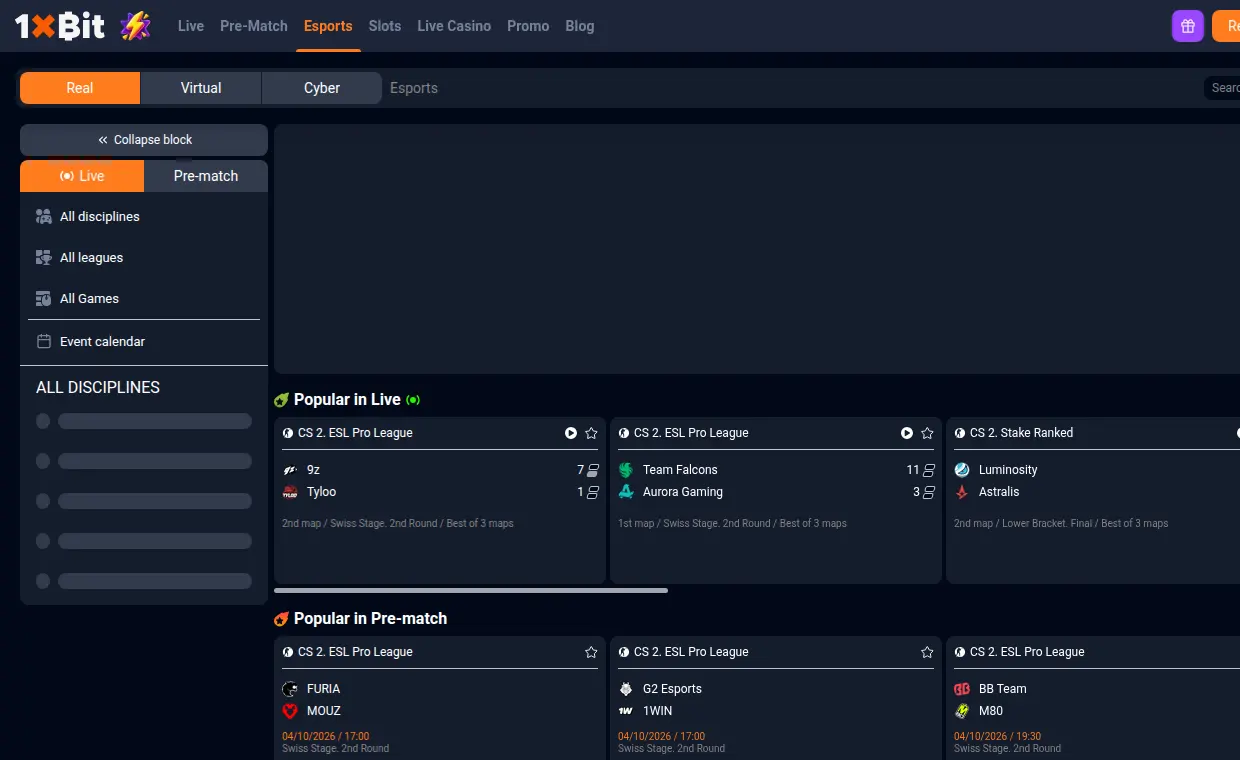
1xBit esports lobby with the SC2 menu (official mirror) - source: 1xbitx.com, accessed 2026-10-04Opening, mid, late - the build-order reads against GSL-class markets
The calendar: GSL seasons and nothing bigger
GSL Code S (three seasons a year). The Korean league is the main
market - match, map and totals menus at the verticals that carry it.
ASL and Brood War siblings. The same Korean-centric liquidity
extends to Brood War at a couple of books - same caveats.
No EWC window. The 2026 festival dropped SC2 [3] - the title lost
its only cross-title liquidity boost.
The thinness is the calendar: outside GSL runs, SC2 betting windows are event scraps. The IEM event page tracks what remains of the old circuit's CS2 legacy.
Live values from our database - details and caveats in each review. "-" = not documented by the operator. "Visit" links may be affiliated.
Baseline: match winner [7]. Deeper menus (map winner, totals) exist at the esports-first verticals [8]. 100% of this page's books run live esports overall; live SC2 is effectively GSL-only where it exists at all.
n/a is the current median sampled margin across this page's books; n/a the sharpest documented sample. The sample base is tiny - class indicators, with capture dates per review.
The build-order read, for what it can express
Openings are information. Scouted openings reveal strategy
families minutes before they resolve - the mid-game reprice on tech switches is the readable live edge where live markets exist.
Composition over macro. Late-game army composition decides more
than economy leads; books that model unit comps price the tails better.
The map pool matters per series. GSL map pools are curated per
season; comfort stats per map are the pre-match read - the same map-pool logic the R6 hub documents, at Korean speed.
The structural catch is the same as every thin market: where only match-winner menus exist, the reads have no market to live in. The depth table IS the product here.
Warnings specific to SC2
Thin liquidity everywhere. GSL fixtures trade with wide spreads and
low limits at every book that carries them. Size for the margin; the betting-cost tool prices the session math.
Event-window drift. SC2 menus appear and disappear with GSL runs;
The shrinking-circuit risk. IEM's wind-down and the EWC drop mean
fewer liquid windows each year - the honest read is that this lane gets smaller, not bigger.
Korean-hours fixtures. GSL fixtures run on Korean evenings - plan
session timing or accept the calendar.
The niche's trajectory, read straight
SC2 viewership is a fraction of the big titles [4] and the structural events of 2026 went against it: the EWC dropped the title [3] and the IEM circuit had already wound down [2]. The honest read is that this lane gets smaller - the remaining product is GSL Code S, three seasons a year, priced at a handful of books.
Two consequences for anyone betting it:
Liquidity is the constraint, not information. GSL has deep public
statistics (build orders, map stats, head-to-heads are tracked obsessively in the community). The market is thin, not ignorant - edges expressed in match-winner prices are small; edges expressed in props have no market to live in.
The Brood War sibling. The same Korean infrastructure runs ASL
(Brood War) - a couple of the verticals list it alongside SC2. Same liquidity caveats, same information depth.
The specialist's honest position: SC2 betting is a preparation exercise with a small expression surface - and that is worth knowing before building anything around it.
The map-pool read, at GSL speed
GSL map pools rotate per season - the R6-style comfort-map logic applies at Korean cadence [1]:
Per-map player stats. GSL's format surfaces per-map records;
player comfort on specific maps is stable and tracked.
Season transitions. New pools reset the comfort stats - the
first series of each season carry reset-uncertainty pricing.
The vetoes are public. Like CS2, map selection is pre-match
information; the market prices the pool, the sharp price the pairs.
The reads are real; the market expression is the constraint. With 5 books, the depth table above IS the market - and the SC2 hub's honesty is that the table is short.
The GSL format, as a market structure
Code S's format shapes what is priceable:
The league rhythm. Round-robin group stages into knockout
brackets - the group stage gives daily fixtures at thin books; the knockouts concentrate liquidity.
Season transitions. Three seasons a year with map-pool rotations
between - the transition series carry reset uncertainty, and the mid-season series carry the stable-window pricing.
The Korean-hours constraint. Fixtures run on Korean evenings -
Western sessions are asynchronous to the market; the live product is a schedule commitment before it is a strategy.
Common failure patterns in SC2 betting
The IEM-era priors. The old international circuit's team
hierarchies are stale inputs - the current market is GSL-centric [1] [2], and the priors that matter are the Korean-league ones.
The build-order overread. Scouted openings reveal strategy
families - the response is standardized enough that the edge lives in execution variance more than in the scout itself.
The liquidity ignoring. SC2 lines are thin at every book;
market orders move prices. Limit discipline and small sizes are the lane's requirements, not preferences.
The SC2 bettor's information stack
The lane's preparation tools are unusually good - the Korean league's data culture is the deepest in esports:
Build-order databases. Community-tracked openings per player
and map - the scouting read's input, public and current.
Per-map records. The same map-pool logic the R6 hub applies,
at player granularity [1].
Head-to-head histories. Matchup histories across seasons - the
matchup-driven pricing CS2 leads with, at GSL cadence.
The stack exists; the expression surface is the constraint. The honest workflow: prepare with the stack, express in match-winner at the 5 books that carry it, accept that the props have no market.
The Brood War sibling, briefly
ASL runs on the same infrastructure, the same Korean-hours cadence, and a couple of the verticals list it alongside SC2. The same reads apply at a different game's speed - build-order scouting, map-pool comfort, head-to-heads. The liquidity caveats are identical; the audience is smaller and older. The lane exists for the specialists who already follow it - and this page documents it rather than pretending it is larger than it is.
The SC2 wrap, and the honest use case
The lane's honest use case in one paragraph: SC2 betting on this site is a shrinking niche lane - GSL Code S, match-winner menus at 5 books, the deepest public statistics in esports and the thinnest market expression. The lane rewards preparation and punishes size; it exists for the specialists who already follow the Korean league and this page documents it without inflating it.
That honesty is the page's product: the depth table is short because the market is short, the map-pool read carries the preparation logic, and the esports-dedicated hub documents where the verticals actually carry the title - everything else on this page is context for reading the niche as it is.
The SC2 session wrap notes
The niche lane's session discipline, itemized:
Sizes at the limits. The thinnest liquidity in the set -
market orders move prices; limits are the requirement.
The GSL calendar. Three seasons a year - the windows are the
schedule; outside them, the lane is scraps.
The information stack. Build orders, per-map records,
head-to-heads - the deepest public data, expressed in the narrowest menus.
The walk-away rule. Too-clean prices on obscure fixtures -
the integrity surface applies at GSL tier too.
Where to go next
~13 esports titles per book is the current median across this page's operators; the books table filters on SC2 coverage live, and the R6 hub documents the map-pool logic SC2 shares.
Hand-built retro scenes that capture the shape of a Bitcoin StarCraft II betting sites match - no copyrighted game assets.
A round in the makingThe higher-level view
Latest videos
Newest from the game's official channel. Thumbnails are served from this site; the player (youtube-nocookie) loads only after you click, so nothing reaches Google before then.
BlizzCon 2026 | Classic Cup: StarCraft Remastered | Entertainment Match2026-09-15BlizzCon 2026 | Classic Cup: StarCraft Remastered | Legacy Match2026-09-15BlizzCon 2026 | Voices of Blizzard | Full Panel2026-09-15BlizzCon 2026 | Localization: Bringing Blizzard's Worlds Together | Full Panel2026-09-14BlizzCon 2026 | Closing Remarks2026-09-14BlizzCon 2026 | Custodians of Legacy Games | Full Panel2026-09-14
FAQ
Is StarCraft II betting still a thing?
It is niche and shrinking - but alive. GSL Code S in Korea is the main circuit left (herO won both 2026 seasons); ESL's IEM SC2 circuit effectively wound down (the last IEM SC2 champion listed is Serral, Katowice 2024), and SC2 was dropped from the EWC 2026 lineup.
What markets exist for SC2?
Match winner, map winner and map totals on GSL Code S fixtures at a handful of books. Build-order and tech-switch props are rare - the specialist edge mostly has nowhere to be expressed.
Which books carry SC2?
A handful of esports-first verticals list GSL matches; some also cover the Brood War circuit. Coverage appears and disappears with event windows - the depth table on this page is the live check.
What is the margin reality on SC2 at crypto books?
Thin liquidity means wider spreads - SC2 samples sit at or above the sector band. The sample base is tiny; every number is a class indicator with a capture date.
When is the SC2 betting peak?
GSL Code S season runs (three seasons a year in Korea) and the ROG/ASL-class events. There is no SC2 anchor inside the EWC anymore - the festival dropped it for 2026.
How do build orders change betting?
Scouted openings reveal strategy families minutes before they resolve; tech switches reprice mid-game. Where live markets exist at all, the mid-game window is the readable edge.
Is Brood War betting related?
Same market family, same Korean-centric liquidity - a couple of the esports-first verticals list Brood War alongside SC2. The same thin-liquidity caveats apply.
Why did SC2 leave the EWC?
The 2026 EWC lineup dropped SC2 (with Rennsport) while adding returning Fortnite and debutant Trackmania - the festival's title mix is a business decision that removed SC2's biggest cross-title window.
Do SC2 outrights exist?
GSL season outrights and event-winner futures appear at a few books around each season; the market is thin enough that the outright is often the only real product.
How do I compare the SC2 books fairly?
Check menu depth in the reviews (match winner only vs map markets) and sample the same GSL fixture across books at the same time. The comparison tool puts books side by side.