VPN-friendly books
Books whose terms welcome VPN use - or at least do not void winnings over it. Clauses quoted per review.
Short answer: No tracked book's terms currently welcome VPN use outright; five operators explicitly tolerate it (Cloudbet, Thunderpick, Dafabet, BetFury, Betify), nine restrict it in writing. The clause, not the connection, is the risk - void-winnings language is the part that costs real money.
Ranked books
No books match this filter yet - check the full table.
The clause, not the connection
VPN marketing in this sector runs one of two ways: "VPN friendly!" banners with no terms behind them, or silence while the terms reserve a winnings-void over proxy use. Both fail the same way - the player discovers the clause at the payout window. This page enforces a single standard: what the operator's published terms actually say about VPN and proxy use, quoted with a date. 0 is the number of books that clear the welcome-tier bar today; the tolerated and restricted tiers are documented below because that is where the real decisions live.
The current tier distribution
n/a of the tracked books' terms welcome VPN use, n/a tolerate it explicitly, and n/a restrict it in writing - the remainder carry no clause at all, which is not safety but undefined discretion. The tolerated tier's clause text is where the usable answers are:
- Cloudbet - terms tolerate VPN use, combined with the fastest documented
payout segment in the field and risk-based KYC. The strongest tolerated file today.
- Thunderpick - terms state VPN use is allowed [5]; the review
documents the dual-license ambiguity (Curaçao entity on one domain, Anjouan on the other) that a VPN user should weigh before building a balance.
- Dafabet - tolerated tier, 2004 operating lineage, and the narrowest
coin list in the tier (BTC, ETH, USDT) - the conservative structural pick.
- BetFury - tolerated terms [4] with the scanner-tool confiscation
clause (4.1.10) documented separately; tolerated VPN does not equal tolerated tooling.
- Betify - tolerated tier with a documented geo-block VPN message on its
main domain (the operator blocks VPNs from unsupported countries at the edge while tolerating them in terms) - the nuance case, documented in the review.
(no books match right now - see the full comparison table.)
The restricted tier: what the clauses actually say
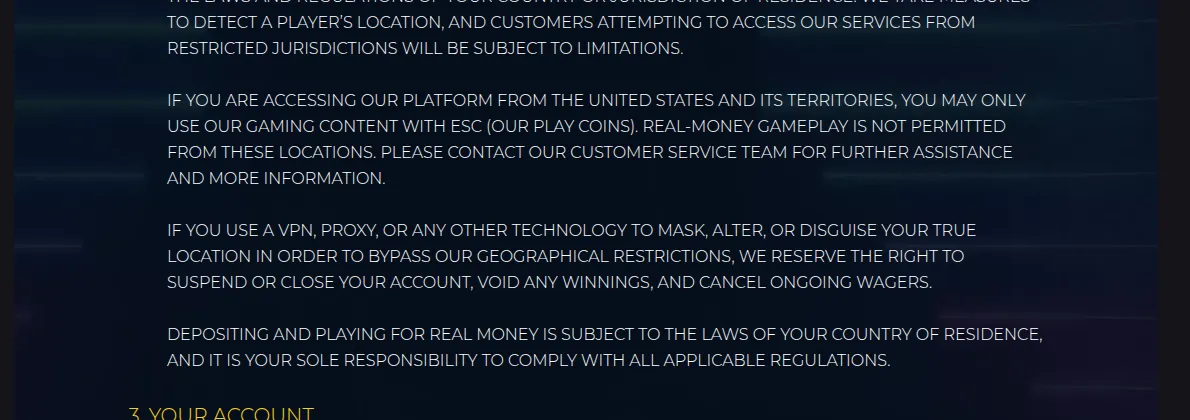
Three clause patterns dominate the restricted tier:
- Blanket prohibition. VPN/proxy use = breach of terms. Stake's terms
carry it at a top-ranked book [3] - the odds quality and the clause risk are separate axes, and this page keeps them separate.
- Void-winnings language. Esportsbet's clause is the explicit form [2]:
proxy use voids winnings. The mechanism is total, and it is the reason "VPN restricted" earns a red badge rather than a note.
- Circumvention framing. The softer wording targets use "to circumvent
restrictions or misrepresent location". It reads as narrower and behaves about the same: the operator's compliance team decides after the fact.
Shuffle's clause 8.4 is the clean prohibited-tier reference [1]. The scam-watch page tracks the enforcement cases where clauses met real balances.
The privacy stack that actually works
A VPN sits in the middle of a stack that starts below the operator:
- Acquisition - the no-KYC purchase routes (P2P markets, ATMs above their
ID thresholds) in the buy-BTC guide keep your funding history off centralized exchanges.
- Wallet hygiene - fresh addresses per deposit; address reuse links your
sessions on-chain [7].
- Session layer - a VPN masks the IP the book logs [7]; Tor does too,
with the exit-node latency cost in live betting [6]. Neither changes the identity the operator's KYC tier can demand - the no-KYC hub documents the trigger ladder.
- Clause layer - the tolerated tier above. This is the only layer with
contract language behind it, which is why it is the one this page ranks on.
The opsec details - DNS leaks, timezone and language fingerprinting, payment-entity mismatches - are documented in the VPN guide. The one-line version: a VPN is a component, not a plan.
Enforcement reality, briefly
n/a books restrict VPNs in writing; enforcement is episodic and account-level, typically at payout review. The pattern that costs players money is consistent across the community record: VPN at a prohibited-tier book, a winning streak, then an ID loop that resolves the geography question against the player. The defense is boring and absolute - match the clause tier to your actual usage before funding, because after funding the clause outranks everything else.
Reading a VPN clause like a contract
The clauses share a grammar, and the differences decide real money:
- Subject of the prohibition. "Use of VPNs is prohibited" bans the tool;
"use of VPNs to circumvent restrictions" bans a purpose. The purpose-form leaves a defense for every use that is not circumvention - which matters only if you can argue it at the payout window, so weight the entity behind the clause accordingly.
- Consequence. Account closure, bet voiding, winnings voiding, deposit
refund - four escalating outcomes that affiliates flatten into "banned". The reviews quote the consequence verbatim because it is the number that prices the risk.
- Detection burden. Clauses prohibit; the operator still has to detect.
Datacenter-range flagging makes consumer-VPN ranges the easy catch; residential-looking exits raise the bar but not to zero. The honest reading: detection is probabilistic and retroactive - the clause applies at payout review, not at login.
- The geo-block nuance. Betify's documented case - VPN-tolerated terms
with an edge-level geo-block that tells VPN users to load a supported country - shows how terms and infrastructure can disagree [5]. The edge block is the operator protecting its license story; the clause is the operator tolerating the tool. Read both.
When the tolerated tier is worth it
For players who need the network layer for reasons other than geo-circumvention (stability on the road, ISP-level issues, shared-network hygiene), the tolerated tier is the honest fit: the clause is written, the payouts proceed with a foreign IP in the history, and the KYC tier does not change (Cloudbet's risk-based file pairs with its tolerated terms [5]). For players whose actual use is circumvention of a restricted jurisdiction, no clause in this set is protection - the operator's license territory and your local law are both outside what a VPN clause can fix [7] [8], and the US players hub documents why the law layer outranks the tool layer.
Warnings
- Clause changes are silent. Terms pages update without changelogs;
the tolerated tier of one quarter can become restricted. The check date on each review is the freshness guarantee - re-verify before any large deposit, not just at signup.
- Payment-entity geography leaks the real policy. An operator whose
payment agents cluster in one jurisdiction while the brand markets globally has a compliance reality that the VPN clause has to coexist with. The reviews track the operator entity; the footer is the source.
- Tor is not a free upgrade. Where tolerated, Tor still adds exit-node
latency to live markets [6] and the operator still sees the session content [6]. It pairs with the tolerated tier, it does not replace it.
- The log is the evidence. Whatever the clause, the operator's decision
at payout review will rest on its own logs - login geography, device consistency, payment history. An account that looks coherent in those logs has a defense; an account assembled from mixed profiles does not. The behavioral floor is part of the VPN guide checklist for a reason.
Where to go next
The books table carries the VPN policy per operator with the check date; the book-check tool assembles the clause dossier per name, and the US players hub documents the law side that no VPN clause can change.
Sources
- Shuffle - terms of use, clause 8.4 (VPN/proxy use as breach - the prohibited-tier reference) - accessed 2026-10-04
- Esportsbet.io - terms (VPN restriction with explicit void-winnings clause) - accessed 2026-10-04
- Stake - terms of service (VPN prohibition at a top-ranked book) - accessed 2026-10-04
- BetFury - terms and conditions (tolerated-tier operator, clause text) - accessed 2026-10-04
- Thunderpick - terms (VPN allowance per live terms; JS app - 403 to datacenter IPs) - accessed 2026-10-04
- Tor Project - what Tor does and does not protect (the operator still sees the session) - accessed 2026-10-04
- Wikipedia - Virtual private network (what a VPN does technically) - accessed 2026-10-04
- Wikipedia - Gambling in the United States (why geo-law, not geo-IP, is the binding layer) - accessed 2026-10-04
FAQ
Which esports books allow VPNs?
Under this site's definition - terms that welcome VPN use outright - none today. The tolerated tier is five operators whose terms permit VPN use or stay silent without void language (Cloudbet, Thunderpick, Dafabet, BetFury, Betify). Anything short of the clause text is the operator's discretion, not your right.
Why is the tolerance bar so strict?
Because the cost of being wrong is total: void-winnings clauses convert your balance to zero on detection. "Tolerated" on an affiliate page means nothing; the same word backed by the operator's published terms is enforceable. This page quotes clause text per review with a date.
Can a book void winnings over VPN use?
Yes - the restricted tier is written exactly for that. Esportsbet's terms contain an explicit void-winnings VPN clause [2], and Stake prohibits VPN use outright [3]. Detection is trivial at scale: the operator compares your login geography, timezone and device fingerprints against your stated country.
Does a VPN make betting legal where it is restricted?
No - it changes the IP the book sees, not the law that applies to you. Geo-restrictions exist because the operator's license and your local law are separate layers; the VPN decision page on this site documents the clause side, and your local law stays your responsibility to check.
What is the difference between prohibited and tolerated in practice?
At tolerated-tier books the payout proceeds with a foreign IP in your history; at prohibited-tier books the same history is a breach. The clause turns on intent language too - "to circumvent restrictions" wording gives the operator discretion that a plain prohibition does not.
Do any books run an onion (Tor) service instead?
The tracked set currently shows no operator with its own onion endpoint; Tor access is treated under the same proxy language as VPNs at clause-first books. Tor has an additional property the terms do not fix: the operator still sees the session, and exit-node hops add latency to live betting [6].
How do books detect VPNs?
Commercial IP-geolocation flags datacenter ranges, known VPN exit pools and geolocation-vs-timezone mismatches. Consumer VPNs cycle known ranges that are flagged wholesale - a "stealth" mode helps with the block page, not with the terms clause if your account says another country.
Is a VPN clause risk worth taking for better odds elsewhere?
Price the downside honestly: the clause converts your entire balance to voidable status. A half-point margin difference is worth cents per ticket; a voided balance is worth everything. Books with tolerated terms and competitive odds exist - start there.
Does the VPN hub page rank any books right now?
No - the ranking bar is terms that welcome VPN use, and that tier is empty. The page documents the tolerated tier and the restricted clause texts instead, which is the state of the market an experienced bettor actually needs.
What should I do before betting over a VPN at a tolerated book?
Screenshot the VPN clause with the date, complete one clean deposit-withdraw cycle early, and keep the account country field consistent with your actual residence - the tolerated tier covers the connection, not a false statement on file. The VPN opsec guide carries the full checklist.