18+ only. Crypto gambling involves risk - never wager more than you can afford to lose. Some links may be affiliate links; rankings stay independent. Gamble responsibly.
Books that accept CS2 skins as deposit or currency - the gamer-native lane, with its own trust questions.
Short answer: Three tracked books accept CS2 skins as deposit or currency alongside Bitcoin betting. Skins add custody and pricing layers on top of normal betting risk - Valve's trade-protection regime (2025) and the October-2025 market crash (~$2-3B) reshaped the lane. Start small, verify withdrawals, read the red flags.
books on this page: 3 · active today (excl. watch list): 2 · pass the recommendation gate: 2 · median documented esports margin: n/a
quick picks
Skin-native brand with match betting and provably fair games→CSGOEmpire - match-betting mode beside its skin economy; help center documents deposits/withdrawals
Skin deposits plus a deep esports-first vertical→Gamdom - skin deposit support documented; risk-based KYC, fast payout segment, dedicated vertical
Skin lane with the longest operating record→EGB.com - dedicated esports vertical since 2013 with skin support - watch status, read the review first
Esports-first crypto book with 11 documented coins and an Anjouan license claim (live 2026-10-04) - license wording changed from Curaçao since September.
Risk-based KYCEsports-firstLive bettingSkins
CS2Dota 2League of LegendsValorant
Instant rakeback welcome bonus (percentage applied for first 7 days after signup; welcome bonus can be disabled at times per server strings)
Skin betting is the lane where the site's usual advice needs the most context: the products are real (3 tracked books accept skins alongside BTC betting), the economics are real, and the risk stack is real too - custody, pricing spread, trade-reversal scams, an operator-terms grey zone and a market that lost billions overnight in October 2025. This page documents all of it; the skin-vs-crypto guide carries the full timeline with sources.
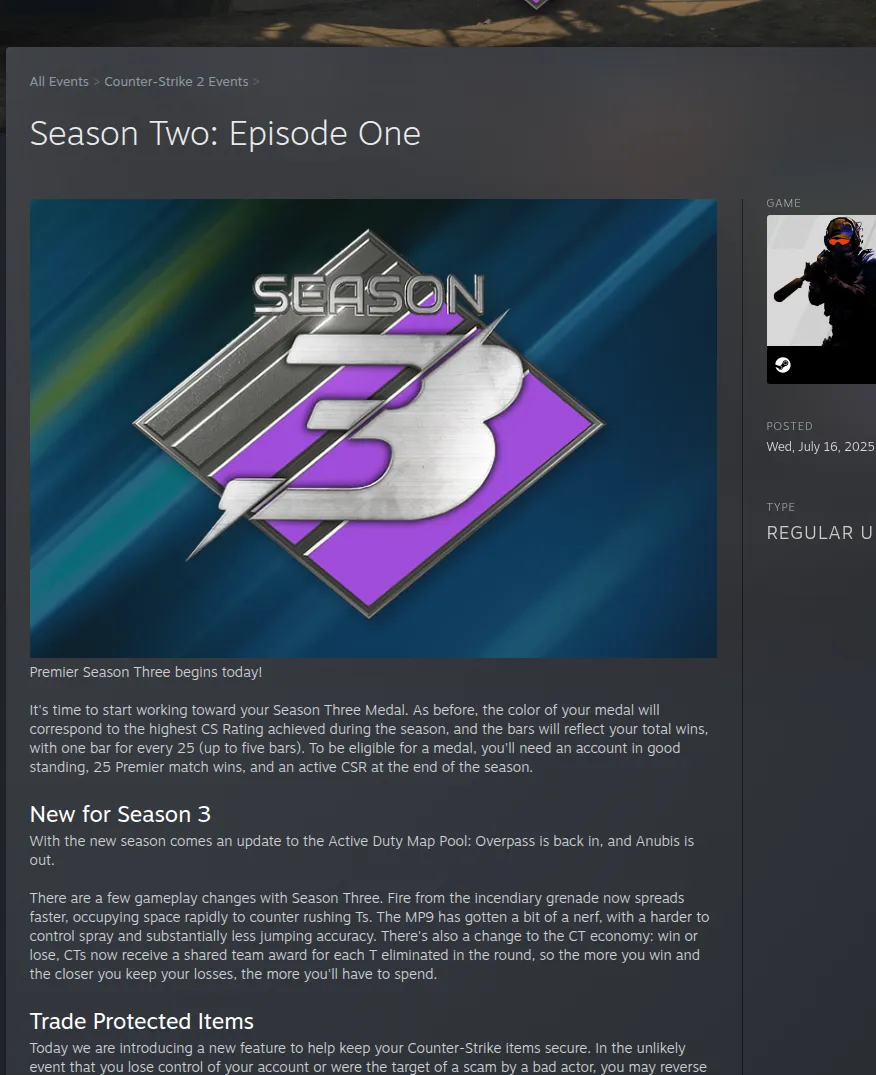
Valve's Steam news hub with the Trade Protected Items update - source: counter-strike.net, accessed 2026-10-04Trade locks, custody, pricing spread - what a skin deposit adds on top of betting risk
became reversible for 7 days [1] - deposit flows and scam patterns both changed. Sites manage reversal risk with trade locks and holds; the reviews document each policy [2].
The October 2025 crash. A CS2 update made rare knives and gloves
dramatically easier to obtain - the skin market lost roughly $2-3 billion in value almost overnight [4] [5]. Skin-priced balances and operator inventories repriced with it: the lane's custody promises got their stress test.
The legal layer adds context: New York sued Valve over loot boxes (February 2026), with Valve responding publicly [6] [7] - the same grey-zone pressure that shapes skin gambling's regulatory future.
Live values from our database - details and caveats in each review. "-" = not documented by the operator. "Visit" links may be affiliated.
Each layer is a real cost or risk:
Trade locks. Sites hold deposits through Steam's trade windows to
neutralize reversals - your deposit sits in escrow-like states before it credits.
Custody and site pricing. The operator prices your items - often
below external market value on deposit, which is a hidden fee on top of the game's margin. Withdrawals re-enter the same spread.
The grey zone. Valve's terms prohibit commercial skin gambling;
the lane operates between that prohibition and offshore licenses where they exist. The reviews state each site's license status plainly.
n/a is the current median sampled esports margin across this page's books and 2 clear the recommendation gate - the game margin is the least of the lane's costs; the pricing spread is the one to capture before depositing anything.
Practical rules for the skin lane
Deposit small, verify the full cycle. One clean
deposit-withdraw round trip (skins in, value out) before scaling - the cycle tests custody, pricing and payout in one move.
Withdraw in crypto. BTC to self-custody exits the pricing spread
and the item-custody stack in one step; the bitcoin hub carries the exit mechanics.
Capture the pricing spread. Market price of the item vs the
site's credit - that gap is the lane's real entry fee. The payment-help tool branches the deposit failure cases.
Watch the red-flag file. The lane's history (unpaid withdrawals,
inventory freezes) lives in the reviews and the scam-watch page.
Warnings specific to skins
Custody is the product. A skin balance is an IOU priced in items
whose market can move billions overnight - the crash proved the mechanism, not an outlier case.
The reversal-scam surface. Trade-protection reversals feed a scam
pattern that targets both players and sites; the sites' trade locks are the defense, and they delay your deposits by design.
The grey zone can move. Regulatory actions (the NY AG case is a
loot-box front [6] [7]) can reshape the lane on legal outcomes. The reviews' dated facts are the tracking instrument.
Bonus and rollover restrictions. Skin-adjacent products are a
common rollover-exclusion class - the bonus hub documents which terms restrict what.
The skin-economy vocabulary, decoded
The lane has its own language, and the terms carry real money:
Float. The item's wear value - the biggest single driver of
item price; the same skin at different floats prices differently, and site spreads vary by float.
Trade hold. Steam's post-trade restriction window - the deposit
delay the sites use to neutralize reversals.
Site inventory. The items a site holds for withdrawals - the
crash showed what happens to site inventories in a market move [4] [5], which is why withdrawal-asset choice matters.
Marketplace vs withdrawal. Some sites let you sell back for
coins instead of withdrawing items - the coin exit skips the item spread and the custody question in one move.
Common failure patterns in the skin lane
The item-price anchoring. Depositing items at sentimental or
pre-crash values - the site prices at its spread regardless; the crash repriced every anchor in the lane.
The withdrawal-asset default. Taking items back by habit - the
coin exit (to self-custody BTC) skips the re-entry spread; the bitcoin hub carries the exit mechanics.
The tier-2 fixture crossover. Skin-native sites' match betting
runs on the same tier-2 integrity surface as everywhere - the skin lane does not suspend the walk-away rule.
The skin-lane legal map, briefly wider
The grey zone has geography - the honest state:
Valve's terms. Commercial skin gambling is prohibited by the
platform's rules - the lane operates in violation-adjacent space by definition; enforcement is Valve's, episodic, and directed at the sites' API access more than at players.
Operator licenses. Where skin sites hold offshore licenses, the
license covers the gambling product, not the item custody - the reviews state which entity holds what.
The regulatory attention. The NY AG action against Valve [6]
[7] and the earlier Dutch trading restrictions [8] are the item-economy's regulatory history - the direction of travel is more attention, not less.
The honest player posture: the lane's legality is unresolved by design; the reviews' dated facts are the instrument, and the exit-to-crypto rule is the hedge that survives any of it.
The skin-site failure archive, summarized
The lane's history concentrates into three failure classes - each with a site-side defense and a player-side check:
Inventory freezes. Market crashes freeze site inventories -
the October 2025 crash is the stress test [4] [5]; the player-side check is the withdrawal-asset rule (coins, not items).
Unpaid withdrawals. The classic; the red-flag files and the
Pricing-games. Spread widening on exotic items at withdrawal -
the spread capture (deposit AND withdrawal quotes) is the check.
The exit-to-crypto rule, argued properly
The skin lane's most repeated advice deserves its actual argument:
The spread argument. Item withdrawals re-enter the pricing
spread - the coin exit skips it. The spread capture section shows how to measure it.
The custody argument. Items in a site inventory are claims on
items; BTC in self-custody is the asset. The crash showed the difference at billions of scale [4] [5].
The optionality argument. A coin balance is spendable
anywhere in this site's lanes; an item balance is spendable at skin sites. The bitcoin hub carries the mechanics the coin exit opens.
The rule's honest counterpoint: players who live in the skin economy (marketplace users) have a real use for item balances - the rule is for bettors whose exposure is betting, not trading.
The skins wrap, and the honest use case
The lane's honest use case in one paragraph: skin betting on this site is the grey-zone lane at 3 books - the products are real, the custody stack is real, the 2025 events (trade protection, the crash) reshaped it, and the honest use is small sizes, coin exits and dated facts. The lane rewards players who treat skins as a deposit method and punishes those who treat them as a store of value.
That honesty is the page's product: the custody figure is the frame, the reviews carry the per-site policies with dates, the skin-vs-crypto guide carries the full timeline, and the scam-watch page tracks the failure archive - everything else on this page is context for playing the lane honestly.
Where to go next
The books table filters on skin support live; the skin-vs-crypto guide carries the full timeline with sources, and the provably fair hub documents the game-logic verification layer most skin sites run.
Depositing in-game items (CS2 weapon skins) as currency instead of crypto - the site prices the skin, your balance converts, and withdrawals can come back as skins or coins. The three tracked books here do it alongside Bitcoin betting.
Is skin betting safe?
It depends entirely on the operator - skins add a pricing and custody layer on top of normal gambling risk. The custody stack figure on this page shows the three layers; start small, verify withdrawals, and read the red-flag list per site.
Do these sites also take Bitcoin?
The ones listed here do - that is the intersection this page covers: skin deposits plus BTC betting under one roof.
What did Valve's trade-protection change do?
The July 2025 update introduced reversible Trade Protected items (7-day reversibility instead of irreversible trades) - which reshaped skin-gambling deposit flows and scam patterns alike. The skin-vs-crypto guide documents the full timeline.
What was the October 2025 skin market crash?
A CS2 update made rare knives and gloves dramatically easier to get - the market lost roughly $2-3 billion in value almost overnight [4] [5]. Skin-priced balances and site inventories repriced with it; the event is the lane's solvency stress test.
How are skins priced on these sites?
The operator prices items (often below external market value on deposit, which is a hidden fee). The pricing spread is the real cost of the skin lane - capture the item's market price and the site's credit to see it.
Can a skin deposit be reversed or scammed?
Trade reversals (Steam's protection system) can claw back deposited items after you have been credited - which is exactly the scam pattern the trade-protection era feeds. Sites manage it with trade locks and holds; the reviews document each site's policy.
Are skin sites regulated?
Mostly not in the licensed sense - the lane sits in a grey zone between Valve's terms (which prohibit commercial skin gambling) and offshore licenses where they exist. The legal pressure is documented (the NY AG action against Valve over loot boxes is a separate but related front).
Should I withdraw skins or crypto?
Crypto, usually - skin withdrawals re-enter the pricing spread and the custody stack. Withdraw in the asset whose custody model you understand (BTC to self-custody) and sell the exposure instead.
What is the honest starting size?
Small by construction - the lane's risks (custody, pricing, integrity, legal grey zone) stack on top of betting risk. Verify one clean deposit-withdraw cycle before scaling anything.