18+ only. Crypto gambling involves risk - never wager more than you can afford to lose. Some links may be affiliate links; rankings stay independent. Gamble responsibly.
Crypto books with real Apex Legends markets - match winner, maps, props and outrights. Coverage depth, margins and payout speeds documented per book.
Short answer: Three tracked BTC books carry documented Apex markets. The ALGS cycle culminates in the Championship (recently January - Year 5 ran at Sapporo Dome, won by orgless Oblivion); battle-royale structure means outright futures carry the real product while match-level markets stay rare.
Esports-first crypto book with 11 documented coins, concrete payout terms and an explicit VPN allowance - license claim ambiguous (dual regulators).
Risk-based KYCEsports-firstLive bettingCashout
CS2League of LegendsDota 2Valorant+12
100% first deposit bonus up to 600 EUR for betting (up to 2,000 EUR for casino); bonus-activating min deposit 20 EUR30x (deposit + bonus); only single wager…
Esports-first crypto book with the deepest documented title list in this set (23-title enum, Jan 2025) - now on duelbits.io under Elevated Entertainment Ltd (Anjouan, no number printed), brand in transition.
Apex Legends betting is the BR-format lane of this site's game hubs: 3 tracked books carry documented Apex markets, and the market shape follows the format - battle royale does not decompose into maps, so the real product is outright and placement futures around the ALGS events, not match-level betting.
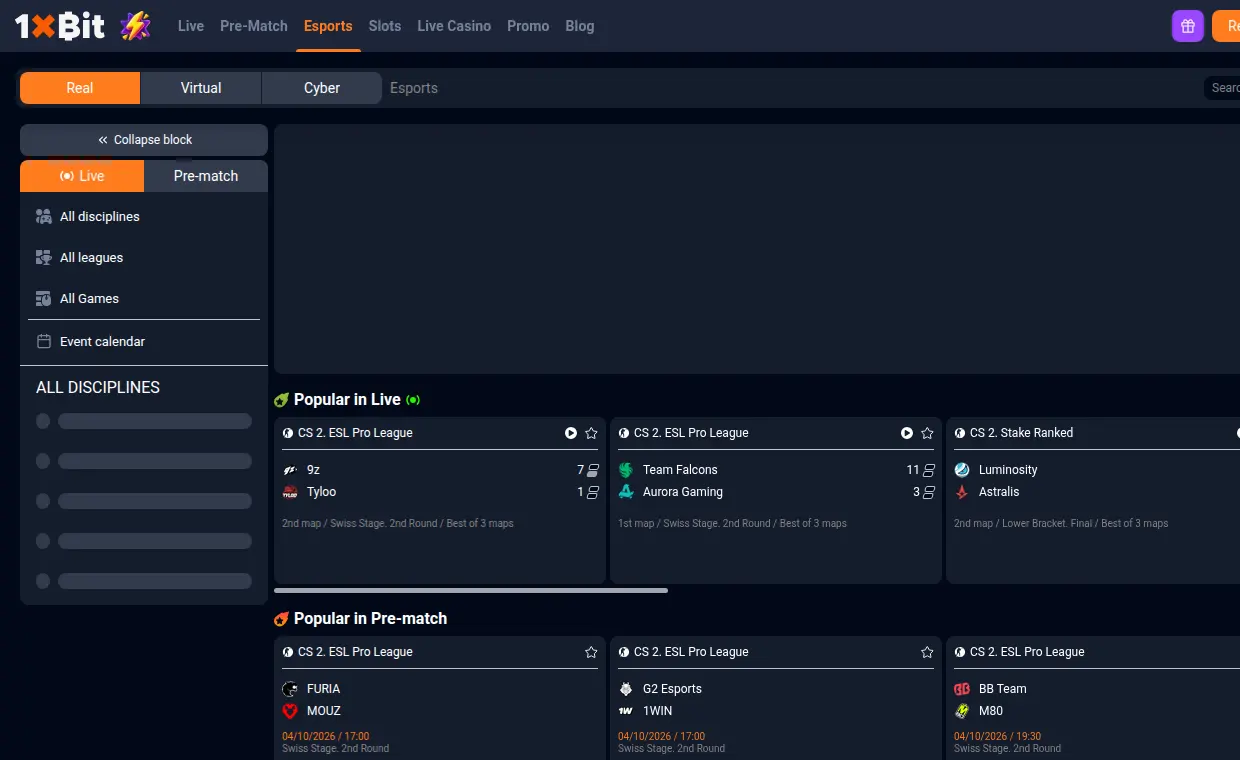
1xBit esports lobby (official mirror) - source: 1xbitx.com, accessed 2026-10-04Point-plus-placement scoring - what markets exist around the ALGS format
The calendar: Championship, splits, EWC window
ALGS Championship. The cycle's finale - Year 5 ran 15-18 January
2026 at the Sapporo Dome, won by unsigned squad Oblivion (the first orgless champion, with a first female coach on a winning ALGS title) [1]. Year 6 followed.
Split playoffs (through the year). The qualification windows feed
the Championship; book coverage concentrates around them at the esports-first verticals [7].
The EWC mid-season event. Year 6's mid-season window ran inside
the 2026 Esports World Cup [2] - the summer liquidity event.
The ALGS event page tracks the annual cycle; EA's competitive hub [6] carries the official calendar.
Live values from our database - details and caveats in each review. "-" = not documented by the operator. "Visit" links may be affiliated.
Outrights and placement futures - the real product: Championship
winner, top-N placements around the finals.
Match-level markets - rare everywhere; BR matches price as one
unit (winner/top-N), with no map decomposition to hang props on.
Live - effectively absent at BTC books; the format gives in-play
nothing to hang on.
~5.8% is the current median sampled margin across this page's books; 5.8% the sharpest documented sample. The sample base is among the smallest on the site - class indicators, with capture dates per review.
What is actually modelable in ALGS
The scoring structure is the model: placement points reward consistency, kill points add variance. The modelable team statistic is the placement distribution - teams with tight top-5 placement profiles are the futures staple; volatile teams are the upset fuel. Oblivion's orgless title run is the reminder that the variance side is real: ALGS outright pricing carries wider uncertainty than league esports, and the honest sizing reflects that.
Warnings specific to Apex
Event-window thinness. Between the Championship and the EWC window,
Apex betting windows are scraps - menus appear and disappear with the ALGS calendar. The changes page tracks observed changes.
The upset-variance tax. BR fields carry genuine chaos; outright
prices embed it. Size for the variance, not the favorite's brand.
Small-sample honesty. The quantified numbers on this page carry the
site's widest error bars - the per-review captures are load-bearing.
Bonus restrictions. Futures and specials are a common
rollover-exclusion class - the bonus hub documents which terms restrict what.
The audience context and the futures case
ALGS viewership sits mid-pack [4] - strong around the Championship, quieter in the splits. The betting market mirrors it exactly: futures windows around the big events, scraps between. The ALGS scoring structure (placement points rewarding consistency) is what makes the futures market modelable at all - the team statistic is placement distribution, not match wins.
The orgless-champion data point deserves its own note: Oblivion's Year 5 title run is the strongest evidence that ALGS fields carry genuine structural variance - unsigned squads beating organizations at the highest level. Outright pricing in this lane must price that variance, and the honest sizing does.
The split structure, as a betting calendar
The ALGS year divides into splits with playoffs - each split is a mini-cycle: qualification, playoff window, futures reset. The practical calendar read:
Split playoffs are the liquidity windows. Books add Apex menus
around them; the futures open weeks ahead at the verticals [7].
The Championship compounds. The year-end event carries the
deepest outright market - the value window opens at the last split's results.
The EWC window interrupts. Year 6's mid-season event inside the
EWC [2] adds a summer liquidity point the old calendar lacked.
With 3 books, the market is the three verticals' menus - the depth table is the whole comparison, and the honest per-review captures are the load-bearing documents.
The ALGS scoring deep-dive
The point-plus-placement structure rewards a specific team profile, and the futures read follows it:
Placement distributions beat match wins. A team that top-5s
consistently is the futures staple regardless of highlight results; the volatile teams are the upset fuel and the drift risk.
Kill-point variance. Aggressive teams add kill-points upside
with placement risk - the scoring mix decides whether a team is a futures staple or an event-level lottery ticket.
The meta patch interaction. Legend balance patches shift the
composition map between splits - the stale-window logic from the shooter hubs applies at ALGS cadence.
Common failure patterns in Apex betting
The match-winner expectation. The BR format has no match-level
decompositions - expecting per-map markets sets up disappointment and sloppy sizing on the futures that do exist.
The org-brand prior. ALGS fields include orgless and Tier-2
promoted squads at the sharp end - the brand is not the prior; the placement stats are.
The event-window overstay. Between the Championship and the EWC
window, menus thin to scraps - staying in the thin menus at wide margins is the expensive way to keep busy.
The ALGS team-profile read, worked
The scoring system makes ALGS the BR title where preparation pays most
the profiles are stable and public:
The placement-staple profile. Teams with tight top-5 placement
rates across splits are the futures foundation - the stat is the scoring system's own product, and the good futures prices embed it unevenly across the 3 books that carry the market.
The volatility profile. Kill-heavy teams trade placement safety
for point upside - event-lottery tickets whose futures value decays with any meta patch that changes pace.
The playoff-cycle read. Teams peak on cycle rhythms - split
results feed Championship seeds, and the qualification window is where the outright value window opens [1].
The read's honest limitation: 3 books, futures-shaped menus - the profile has expression only in outright and placement markets. The depth table is the product; the profile is how to read it.
The Apex meta, briefly
Legend balance patches shift composition viability between splits - the shooter-hubs' stale-window logic applies [6]:
Significant patches reset the composition map in the two weeks
after; split playoffs near patches compress the window.
The mobility metas move pace-of-play - placement distributions
tighten or widen with the meta, which feeds straight into the futures profile read.
The lane's summary: the least-decomposable format with the most legible team statistic - preparation expressed through futures, at the 3 books, on a calendar the ALGS event page tracks.
The Apex-lane wrap, and the honest use case
The lane's honest use case in one paragraph: Apex betting on this site is event-window futures at a small set of books - a preparation-exercise lane for bettors who follow the ALGS circuit and a skip for everyone else. The reads are real (placement profiles, the scoring math), the menus are futures-shaped, the windows are the Championship and the EWC - and the lane's summary is that it is exactly as small as the format makes it.
That honesty is the page's product: the books table carries the live coin and depth facts, the ALGS event page tracks the calendar, and the per-review captures document what each book actually carried and when - the standard every claim on this page is held to.
The ALGS futures read, one worked pass
The profile read in action, once concretely:
Pull the placement distributions. The public ALGS stats
(placement rates across the current split) - the scoring system's own output, per team.
Separate the profiles. Tight top-5 teams (the staples) vs
kill-heavy volatile teams (the event tickets) - two different futures instruments.
Price against the field. The outright markets' implied
probabilities vs the placement stats' consistency - the gaps are the read, at whatever 3 markets exist.
Size for the variance. BR fields carry structural chaos - the
orgless-champion precedent prices the tail, and the sizing respects it.
The pass is the lane's entire method - and it runs on public data at event windows.
Where to go next
~15 esports titles per book is the current median across this page's operators; the books table filters on Apex coverage live, and the PUBG hub documents the sibling BR market for comparison.
Hand-built retro scenes that capture the shape of a Bitcoin Apex Legends betting sites match - no copyrighted game assets.
A round in the makingThe higher-level view
Latest videos
Newest from the game's official channel. Thumbnails are served from this site; the player (youtube-nocookie) loads only after you click, so nothing reaches Google before then.
How do Team Liquid feel after winning LAN? #ALGS #apexlegends #apex #apexclips #apexlegendsclips2026-11-05What was TL thinking during their LAN-winning game? #ALGS #apexlegends #apex #apexclips2026-11-05Pro Predict How Many Kills They're Gonna Get... Gone Wrong 😭 #apexlegends2026-11-04Zer0 was predicting the future 🤯#apexlegends2026-11-03What is your favorite Heirloom in Apex? #apexlegends2026-11-03Is Carter Just Aim Training at ALGS!? #apexlegends2026-11-03
FAQ
Can I bet on Apex Legends with Bitcoin?
Yes, at a small subset of books - ALGS Playoff and Championship outrights appear around the events; match-level betting is rare because the battle-royale format does not decompose into maps.
What is the ALGS format?
EA's Apex Legends Global Series - a yearly cycle with Split playoffs culminating in the ALGS Championship. Scoring combines match points and placement points; the Year 5 Championship ran 15-18 January 2026 at Sapporo Dome, won by unsigned team Oblivion - the first orgless champion.
When is the Apex betting peak?
The Championship window (recently January) and the mid-season EWC event. Between those, Apex betting windows are event scraps at BTC books.
What markets exist for Apex?
Outrights and top-N placement futures around the ALGS finals; match-level live markets are rare - the BR format gives books little to price mid-match.
What is the margin reality on Apex at crypto books?
Where markets exist, samples sit in the sector band - but the sample base is among the smallest on the site. Class indicators with capture dates, not precision rankings.
How does Apex compare to PUBG for betting?
Same BR constraint - futures over live - with a tighter scoring structure (point-plus-placement) that makes placement consistency the modelable stat. The PUBG hub documents the sibling market.
What does the orgless champion mean for pricing?
Oblivion's Year 5 win (unsigned, first of its kind) is a reminder that ALGS fields carry genuine upset variance - outright pricing in BR titles carries wider uncertainty than league esports.
Does the EWC add Apex markets?
The Year 6 mid-season event ran inside the 2026 Esports World Cup [2] - the festival window is Apex's summer liquidity event.
Do ALGS outrights open early?
Around Playoffs and Championship weeks ahead at the dedicated verticals; regional futures are rare at BTC books.
How do I compare the Apex books fairly?
Sample the same event's outright market across books at the same time and check menu depth in the reviews. The comparison tool puts books side by side.